Where in Phuket Should You Rent a Villa?
There's no single best area of Phuket to rent a villa in; it comes down to what a normal day looks like for you. Most people who want quiet end up in the north near the airport, around Nai Harn or on Cape Panwa, families tend to settle in Bang Tao and Laguna or in Rawai, Nai Harn and Chalong in the south, and anyone without a car does best in Patong, Kata or Karon. If you were hoping for a secluded cove with city life outside the gate, it doesn't really work like that here, because the island takes over an hour to drive from end to end.
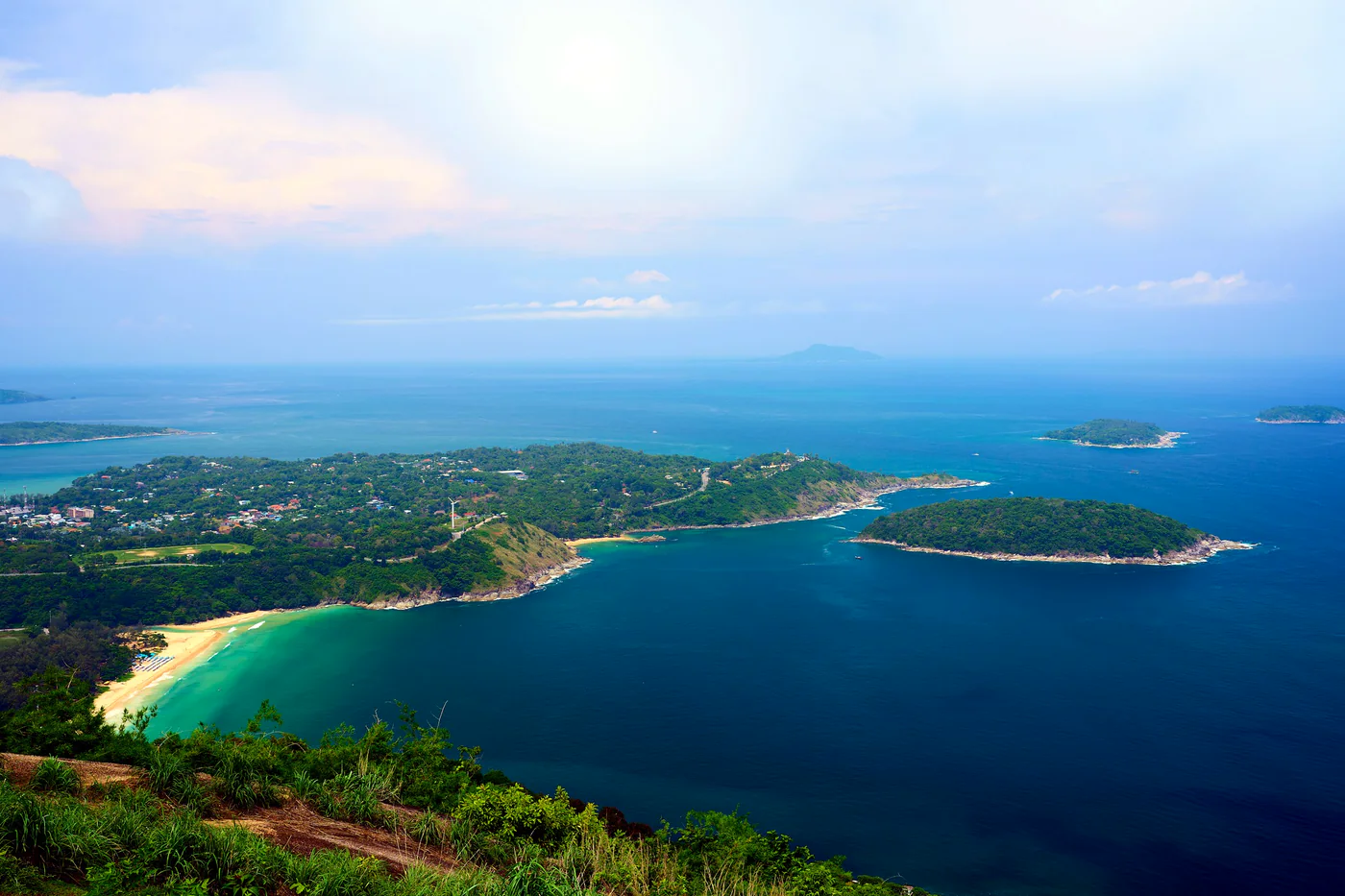
Updated 2 October 2026
- How is the island divided?When we help someone choose, we start by drawing the island in four pieces.
- Which area fits which kind of stay?Short answer: the best area is wherever your ordinary weekday involves the least time in the car.
- West coast: beach towns and quiet baysThe west coast is for people who want the sea at the door, and the question there is really whether you'll live on foot or on wheels.
In this article
How is the island divided?
When we help someone choose, we start by drawing the island in four pieces. The north is the airport, a national park and a handful of villages by long, empty beaches. The west coast is one bay after another, resort streets mixed in with ordinary lanes. The south is the cape with Rawai and Nai Harn, where people come to spend the whole winter, while the east hangs on Phuket Town: further from the sea, but close to hospitals and the big shops.
After that we ask what the stay is actually for. Peace and quiet? Kids in school? Work calls at odd hours? No car? Each answer rules out half the island, and only then is it worth looking at streets and houses, since a quiet lane and a strip of bars in the same village can feel further apart than two neighbouring areas.
If that sounds like a lot to untangle from home, tell us in the chat what your normal day involves, plus your dates and how many bedrooms you need. We'll suggest an area first and then send houses there that we've seen ourselves, weak points and all. If you are looking at the island as a place to buy rather than rent, start with can foreigners buy a villa in Phuket, which covers the land lease and the house.
Which area fits which kind of stay?
Short answer: the best area is wherever your ordinary weekday involves the least time in the car.
If quiet is what you're after, look north near the airport, around the lake at Nai Harn or out on Cape Panwa. Evenings there are the sea and the cicadas, not somebody's speakers. You do pay for it in distance, though, and a pharmacy run or a doctor's visit turns into a drive.
Families usually want flat streets and a short school run, which points to Bang Tao with Laguna in the north-west or to Rawai, Nai Harn and Chalong in the south. We always suggest picking the school before the area, and our page on areas for families goes into that in more depth.
Without a car, life works in Patong, Kata and Karon, where the shop, the pharmacy and the beach fit into one walk. Patong gives you the most within reach, and plenty of noise to go with it; Kata and Karon are calmer and sit on the same coastal road.
Remote workers staying for the winter mostly end up in Rawai or Chalong. Life there doesn't fold up when the tourists leave, and the lanes are quiet during working hours. The one thing people grumble about is Rawai's sea, which is shallow and drains far out at low tide, so they drive over the hill to Nai Harn or Ya Nui to swim.
West coast: beach towns and quiet bays
The west coast is for people who want the sea at the door, and the question there is really whether you'll live on foot or on wheels. Headlands split the bays, so getting to the next beach usually means driving over a hill.
You can live on foot in the middle and south of this coast. In Patong, Karon and Kata the shops, pharmacies and sea are all a short walk away; what differs is the noise and the hills. Patong has the most going on, but you'll only sleep well a few streets back from the beach. Karon is flatter, with a wide promenade along the sand where people push prams, and it goes quiet earlier in the evening. Kata is smaller, and nearly every street in it goes uphill.
Happy to drive? Then the north-west gives you room. Bang Tao and Laguna have a long beach, shopping streets by the Laguna entrance and schools out towards Cherng Talay, but you reach all of it by car, and in season the junction before Laguna backs up. In between sit the calmer bays of Surin and Kamala, with the sea close to the house and no resort strip, while the big shopping trips happen in the neighbouring areas.
South and east: lived-in streets
The south is the most residential part of the island, where people come to live rather than holiday, and the choice is between a swimming beach at the door and errands within reach. Nai Harn has a beach where people swim calmly in winter and a lake for evening walks, but the drive to a flight crosses the whole island. Rawai has boats along the shore and nowhere to swim, yet almost every weekday errand is settled inside the area.
Chalong has no beach at all. People pick it for the big roundabout with roads to the town, Kata and Rawai, and for the large supermarkets and schools close by. South or west is the usual fork for anyone staying a long time, and our comparison of Bang Tao or Rawai lays it out point by point: space and newer houses against lived-in streets and neighbours who stay all year.
The east suits people for whom the town matters more than the beach. Cape Panwa sits in the south-east, its water is calmer in summer than on the west coast, and errands mean a drive to Phuket Town, where the large private clinics are.
North near the airport: space and planes
The north is the quietest and greenest part of Phuket and the closest to the airport. Nai Yang and Mai Khao sit on the shore of Sirinat National Park, where the beaches are long and empty, and from November to February sea turtles sometimes nest at Mai Khao.
When people look for a house in Thalang, they usually mean the inland north: Thai villages along the highway, pineapple fields and the hills of the Khao Phra Thaeo reserve with its waterfalls. There is no sea by the house, but a district hospital and a Thai market are nearby.
The north has two drawbacks. The runway ends at the southern edge of Mai Khao beach, and in houses close to it flights are heard all day. The other is distance: Rawai and the markets of the south are about an hour away, so life centres on your own village, Thalang and the shopping streets of Bang Tao.
Worth knowingBefore booking anywhere near Mai Khao or Nai Yang, ask the owner directly whether planes pass over the house. On a map the runway can look far away; inside the bedroom the answer is often different.
How do you test an area against your week?
Test an area by your daily routes, not by a map of beaches. Mark the three places you will go most often, such as the school, the supermarket and the gym, and drive there from a specific house at the morning hour. An extra climb or a queue at a junction twice a day is felt by the second week.
Then look at what surrounds the plot. Recent satellite images show empty lots and foundation pits, while a bar round the corner or an open-air venue with music only shows up on a walk or in a chat with the neighbours. For the house itself, the villa inspection checklist gives the order we use.
- Is the street level or uphill — that decides whether you will walk anywhere
- Any empty plot next door — machinery and pits show on recent satellite images
- The drive to school, shop and doctor at the morning hour, not late at night
- Do the cafés and shops nearby stay open from May to October
- In the north — how far the house is from the runway and whether planes fly over it
- Can you hear bars or the highway in the evening — ask the owner and walk the street yourself
TipStuck between two areas? Rent the first two weeks in one and visit the other on a weekday, at the hour you would drive to school or training. An unfamiliar area seen in your own rhythm says more than any write-up.
Questions people ask
Is there an area where nobody will build next door?
No area can promise that; only a specific street can. New houses appear all over the island, most visibly around Bang Tao, so check recent satellite images and ask the owner what will happen to any empty land nearby.
Where is it quiet in the evenings?
In the north by the national park, around the lake at Nai Harn, on Cape Panwa and in the lanes of Kamala. Busy areas have quiet streets too: in Patong away from the beach blocks towards the hill, in Kata higher up the slopes.
Can you live in Phuket without a car or scooter?
Yes, if you choose a walkable area such as Patong, Kata or Karon. Elsewhere pavements are scarce and villages are far apart, so groceries come by delivery and trips to town or a doctor are made by taxi.
Which area suits people who fly often?
The north. From Nai Yang the terminal is a few minutes away and from Thalang and Mai Khao a little longer; from Bang Tao and Laguna it is about half an hour, and from the south about an hour.
Which area should we pick for December and January?
Pick by daily life rather than weather. In winter the sea is calm on almost every beach and the beach cafés run at full strength, and good houses in popular bays for those months go early, so start looking well ahead.
Will the sea be swimmable if we stay through the summer?
Not on every coast. From May to October the south-west monsoon brings waves to all west-facing beaches from Mai Khao to Nai Harn, while the pier at Rawai and the east side by Cape Panwa stay calmer.
Send your dates — we will send villas that fit
Area, dates, how many adults and children. We reply in writing, with the house, the terms and the deposit spelled out before you book.